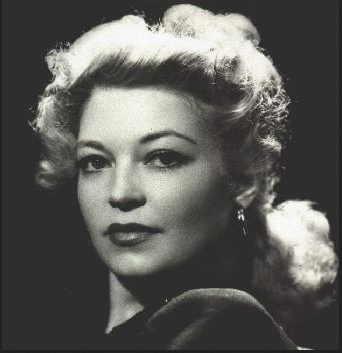
MADAME FIFIE MALOUF, SHOWN ON THE RIGHT WITH PAULINE PAGE OUT
FRONT OF HER HAPPY HOUR CAFE ON THE STRAND IN REDONDO BEACH
All kinds of stories circulate around Fifie Malouf, who, over time, has been reputed by many, including even a few family members, as having been a "madam" --- that is, running a house of ill repute, otherwise known as a brothel, in Redondo Beach, California --- especially so during World War II and then some eight years thereafter. Others vehemently dispute the fact.
True or not, separating fact from fiction when it comes to her background, that is, who she was or was not, what she did or not do, etc., isn't easy. Why? Mostly because of the two types of people that seem to spend time hashing over her history. Specifically, there are those who make record of her life that have a tendency to lean toward the view that being a madam is kind of colorful, and being colorful, only adds to a wider wanting-to-be-acceptable view of Redondo's onetime, nostalgic, underbelly. The recorders of her history in the other camp, those that do not view prostitution as being nearly so colorful generally, nor that it would particularly present a respectable image or maybe even tainting her image, most often play-down, gloss over, deny, or delete almost any references that place Fifie into any such a role.
My own personal experience is aligned with the first camp, although truth be said, I have no hands on experience participating in any such endeavors so provided by her enterprising offers. Matter of fact, I was just a kid when I first met Fifie Malouf and barely into my teens the last time I saw her.
My parents lived in Redondo Beach when I was born. My younger brother came along three years later and, for reasons unrelated to his birth, it wasn't much longer after that than my mother's health began to deteriorate. As she became more and more immobilized my father started to farm my two brothers and myself out to others on a more-or-less regular basis. She eventually reached a point that she had to be placed into an around-the-clock care facility. Inturn we went from conventional short term babysitting during the day to being with our grandparents overnight or to others several days a week, as my father continued --- because of mounting medical expenses --- to put more and more working hours in to make ends meet. Before most of that happened, unlike my brothers, I was sent to live with a couple that, unbeknownst to my father and without his approval, immediately left the country and took me to India.(see) When the couple returned many months later they dropped me off totally unannounced and without any pre-arrangements at my grandmother's on my father's side in Pennsylvania. In the meantime my mother died and when I was finally returned to California not only had I missed any final goodbyes but her funeral as well. After a short stint with my grandmother on my mother's side I ended up living with a foster couple that I had never seen or heard of in my life who owned a flower shop on Pacific Avenue down and around the corner from the old city hall and jail in downtown Redondo Beach.
The above photo shows the main Redondo Beach business district sometime in the 1940s, looking all the same as it did when I was sent to live with the flower shop people. Shown is the era's downtown main street, Pacific Avenue, looking downhill slightly toward the northwest. Benita Avenue crests up the hill toward the old city hall. The flower shop was located ground level on Pacific Avenue about where the first awning is, just past the telephone pole, center right. As you can see the multi-story building is wedged shaped. The front of the shop faced Pacific Avenue but went clear through the building with a working entrance on Benita. The flower shop couple I was sent to live with didn't live in Redondo however, but in a house not far away that opened directly onto Pacific Coast Highway in Hermosa Beach. I attended Pier Avenue school in Hermosa Beach, also on PCH, but almost all of my non-school free time was spent in and around downtown Redondo and the front.
Not liking the arrangements for reasons I am not able to remember, I ran away from home. Without anybody knowing where I was or having anybody's consent to do so I ended up staying with an only recently discharged World War II ex-Marine taxi driver that had fought his way up through all the islands in all the major battles in the Pacific from Guadalcanal northward. The taxi driver and I would have breakfast several days a week at Fifie's Happy Hour Cafe and sometimes I would hang out in the cafe in the afternoons or evenings while the ex-marine "visited a friend" in one of the apartments attached to or nearby the cafe. As a young boy basically left unattended in the cafe every now and then, it wasn't long before some of the women who were associated with Fifie in some fashion, and who joined us for breakfast once in awhile or bought me a malt or a coke in the afternoon, befriended me.[1]
It was during those breakfasts or afternoons that I, although sitting in on but not typically an active participant because of "just being a kid," overheard a number of interesting stories. Two conversations I recall most vividly. The first involved Fifie. How accurate it is I cannot say, however, going back in time, facts and dates seem to substantiate its accuracy.
Fifie was born in 1886. Apparently, at age 14 she attended the Exposition Universelle of 1900, a world's fair held in Paris, France. By 1907 she had married the first of a multiple list of husbands followed by marrying her second in 1910, divorcing him in 1913. Then for six years she basically disappeared only to show up again in 1919 marrying her third husband. It is during those missing years that the first story shows up.
According to a couple of the women that were associated with her and chit-chatting one afternoon between themselves at the Happy Hour Cafe with me sitting with them, Fifie became enamored with Paris and France when she visited the world's fair and had been chaffing at the bit to get back. When she divorced her second husband in 1913, as soon as she could she headed back to Europe and Paris. However, no sooner had she arrived in Europe and settled in than in 1914 World War I broke out and the whole of the continent went into disarray, and she ended up being trapped somehow with no immediate way out. Without getting into all of the details of how she survived or what she did during the war years in Europe they did say that at the end of the war in 1918 Fifie was smuggled along with a couple of other women onto a troopship that was returning G.I.s to the U.S. and by the time the ship arrived in New York she was rich.
After that cash was never a problem. In 1919, a few months after the war, she popped up out of nowhere marrying her third husband, Willard Hoster. In 1923 she and Hoster moved to Redondo Beach.[2]
The second of the two conversations I remember most vividly revolves more around the location of her place the Happy Hour Cafe and some of her associates than Fifie herself. Again, as with the first conversation I was sitting in the cafe with a couple of the women, only this time the ex-marine taxi driver was there as well. Another ex-marine who apparently knew one of the women stepped up to our table and invited himself to join us. It wasn't long before the two former marines discovered they both had been on Guadalcanal and in the process began to dominate the once shared conversation with nothing but war stories. That is, until the self invited ex-marine interjected a story about an unusual situation he observed. In August 1942 he was on Tulagi Island, a short distance southwest of Guadalcanal when he and a bunch of other marines observed some sort of flying objects that were different than anything he had ever seen. He said they were round and nearly flat, shaped almost like an upside down tin pie plate, with no wings or fuselage, glistening with a silver sheen.[3] With that one of the women butted in and told the ex-marine that was nothing because one night in February 1942 right there on the Strand, just south of the Edison steam generating plant, a huge, giant object, as big as a locomotive, came in off the ocean and flew right over the top of the Happy Hour Cafe and the apartments. She had heard a ruckus going on outside, sirens, guns firing, all kinds of stuff, so she went out on to the Strand only to see this "thing" a few hundred feet above the beach slowly glide overhead off the ocean, not making a sound and, because of its length, taking forever to pass over. The two ex-marines just looked at each other and went back to telling their war stories. I knew the event she was talking about because I had seen the object myself. Not only did it apparently fly over the Happy Hour Cafe, it flew right over the top of my house as well. About the object, which has become known as THE BATTLE OF LOS ANGELES: 1942 UFO, the following is presented in World War II Comes to Redondo:
"During the intervening period the the giant object of unknown origin, said to be 800 feet long --- the size of a
Zeppelin --- withstood the continued pounding of 1440 direct hit anti-aircraft rounds with no signs of any ill effect. Eventually it headed back toward the coast turning south past the beach cities of Manhattan and Hermosa. When it reached Redondo Beach it turned inland again then south back out to sea between Long Beach and Huntington Beach, never to be seen again. The the true aspects of mystifying incident have never been answered. Some say it was the Japanese, although after the war they completely refuted any implication in the event. Others say it was pure mass hysteria. Without answers, a strong string of out-of-this world extra-terrestrial connontations has blanketed the phenomenon."(source)
REDONDO'S UNDERBELLY --- OR NOT!
Getting back to Fifie herself, as for any potential city or South Bay historians and the like playing down her role or any potential exposure of an undebelly, it is pretty obvious that at onetime Redondo, especially during World War II and slightly before, was a wide open city --- at least along the front. After all, it is a known fact that mobster Les Bruneman, strolling down El Paseo with a couple of molls under his arms, was shot in the back by a contract hitman almost right in front of the Fox theater. So too, there were the gambling ships off the coast as well, so having a brothel one way or the other wouldn't affect an image much. Besides, in the era we are talking about it wasn't just Redondo. In Stepmother, writing about the late 30s and into the 40s in the Los Angeles area and the corruption that existed under L.A. mayor Frank Shaw and his enforcer brother Joe, the following is presented:
"Historian Dr Kevin Starr, in his book THE DREAM ENDURES: California Enters the 1940s (1997), writing about about Shaw's mayoral regime in Los Angeles, tells how by 1937 he and his brother Joe either particpated in or let happen (with substantial kick-backs together with a number of police on the take) a network of brothels, gambling houses, and clip joints, all of it run by well-organized syndicates with reportedly an estimated six hundred brothels, three hundred gambling houses, eighteen hundred bookie joints, and twenty three thousand slot machines."
So, regardless of any underbelly, preceived or otherwise, in Redondo it was mild. As for Fifie herself, although she did not promote being tagged as a madam she didn't run from it either. However, regardless of what she may have learned or earned on a troopship one way or the other she never thrust herself into a madam role, it sort of just took on a life on its own over time. In the early days of World War II and just before, with Redondo having practically a wide-open front along El Paseo --- but being far enough away from the concentrated Navy action in and around San Pedro and Long Beach that Shore Patrol presence was minimal --- Navy personnel and other servicemen found it increasingly attractive. So too did the women who plied their trade. Plus Redondo was psychologically closer for most So Cal based sailors and servicemen than either Hollywood or Los Angeles. It had a more hometown feel and way less pricey with little or no mob presence say like the operations run by Brenda Allen in L.A. for example. With a hands off policy by the city, or at least a more-or-less look the other way policy, it wasn't long before the close-by apartments owned by Fifie along the north part of the Strand with easy access to El Paseo were discovered. It wasn't long after that Fifie discovered that a highly lucrative financial mutual arrangement could be put into place between herself and any women so interested. Thus grew the legend.
FIFIE'S NEPHEW ADDS A FEW PERSONAL INSIGHTS:
A close relative of Fifie's, a nephew, Willard Firth Zahn (1922-2015) born in Redondo Beach and named after her third husband Willard, had been in contact with me via email on-and-off over a period of time that ran roughly between April 14, 2013 to October 5, 2013. Willard opened his very first email kind of aggressively in the subject line, as well as closing that same first email with: Fifie's return to Paris during the WWI war years is pure fantasy. Even so, aggressive or not, I have to admit he was most gracious and mellowed over time, especially so as the two of us shared more-and-more between us about Redondo Beach generally and discovered, even with our age differences, that we had several mutual acquaintances in common.
Initially the nephew's clear-cut unfettered flat-out meaning in what he says was of course, at least in how he viewed it --- while being bolstered by the position of being a close relative in what he may or may not have become privilege to over the years --- is that what I have presented regarding Fifie's return to Paris during the WWI war years and working her way back is, as he says, pure fantasy --- a position from of which he never waviered.
As with most well written and informative emails, his was most welcome, as can be well attested to through my use of it here. Between our first and last email Fifie's nephew summed up a great deal of information on her, including maternal and fraternal sides of her family that is most interesting, stemming from his own seemingly inexhaustive ancestry research as well as his knowledge as an immediate relative. He also included a number of sources available to those so interested regarding Fifie's life and background much more in-depth than what I provided through my research and own personal remembrances in having known her and crossing paths with her on and off over time as a young boy, come teenager growing up circa 1940s-1950s. Some of what he suggests can be found at the Morrell House, meeting headquarters for the Redondo Beach Historical Society, with additional news clippings, etc., located in the Redondo Beach Historical Museum's Queen Anne House.(see)
The following two back-to-back paragraphs, unedited for the readers here, including the space between the paragraphs, after a number of long lead up segments, were included in his first email:
"I inherited four large scrap books belonging to Fifie. She was a fashion plate and photographer; loads of postcards and newspaper articles. Cards to Mrs. Jack Montgomery were dated 1910-13; Jack has some early connection with Mexico City and I did not find a CA marriage license. He and Fifie had a franchised Fresno Raisin Candy business; she toured several of their outlets from Los Angeles to Boston in 1913.
"Willard Stanhope Hoster married Fifie in Santa Rosa 2 Nov 1919 [marriage certificate and lots of news coverage]. They built a pool on their property and made it a business--public swimming; lessons, baptisms, weddings, etc. In 1923 they built the MT. Lebanon apartments at 326 Strand, the opposite corner of Beryl on the ocean in Redondo Beach. I was named after Uncle Willard. He managed local roller skating rinks and Fifie managed the Happy Hour Cafe that was attached to 400 Strand, and connected to Teckla's residence and the alley. During the destructive storm seasons of the late '40s and early 50's, the front of the buildings were boarded up and access was thru the alley."
[4]
Except possibly for what shows up in the Footnote [4] link, the strongest case for my side of the story as presented --- that is, as it has been presented here after having been personally privy to the conversation between the two women in the cafe --- has always been the framed picture of Charles Nungesser that Fifie had on the wall of her establishment. The fact that the photo depicted Nungesser had long been confirmed to me by the oil well man, so noted in Footnote [2], who frequented the Happy Hour Cafe, had flown in WW I and knew Nungesser. One day the oil well man brought in a number of photographs of himself in WW I flight regalia sitting in and standing in front of biplanes during the war and spread them out all over for Fifie to look at. When he left Fifie gave him the picture of Nungesser, afterwhich I recognized it and saw it many times in conjunction with the other photographs at the repairman's shack where he lived in the oilfields along the Redondo Beach city line just east of Prospect Avenue. Fifie's usual response of "Ooh, la, la" as noted in Footnote [2], previously cited, always seemed to put the final touch on the story as I heard it.
However, truth be told, even my assurances as I view them could be waylaid into the realm of fantasy. I suppose there exists a remote possibility, however slim, that Nungesser and Fifie may have met under circumstances other than the two of them being in Europe at the same time during World War I, the conversation between the two women notwithstanding.
It just so happens starting in 1925 Nungesser was in the United States for three years participating in air races, doing stunts at county fairs, and taking spectators for rides. He also did stunt flying for the movie "The Sky Raider," with most of the filming done in southern California. With the release of the film, the studio, as an advertising ploy to attract potential movie goers, sent Nungesser on a nation wide tour doing stunts over the cities where the picture was being shown. In Denver a weld broke loose on one of the motor mounts causing the plane to shake so violently Nungesser was barely able to get the thing on the ground safely. The tour was interrupted and the plane shipped on to Santa Monica for repairs. After the repairs, Nungesser did stunt flying each day over the Pantages Theatre in Hollywood until the end of the picture's showing. All of which taken together, if one were to consider it, opens up a three year window of opportunity for Fifie and Nungesser to have crossed paths in U.S. --- especially considering the time he was on the west coast.
Pauline Page, so identified in the photo at the top of the page with Fifie Malouf, was eventually to, and did so, play a major role in my life and one of the reason why Fifie stands out to me so much in my life as well. It was in the overheard conversation with the women in the cafe that I first heard the name Pauline Page and, although she wasn't at the table that day, it was through her in later years, after we met, that Fifie's war time Paris trip was confirmed. It was Pauline's versions of the facts that put Fifie's nephew into a tizzy, and of which in the end I didn't use.[5]
PAULINE PAGE
Page had been an entertainer with the USO during World War II, billing herself as Pauline Page and Her All Girl Band. Near the end of the war she became associated with both Brenda Allen and Fifie Malouf as well as my stepmother, and then, eventually, after meeting my father through my stepmother, to whom of which he was still married, falling madly in love with him. Seeing it was not going to work she married a former sergeant she met while touring with the USO who had never stopped pursuing her. They moved into one of those look-alike every other house had a reverse floor plan tract homes that were springing up all over after the war and while he went to work for an aircraft factory she stayed home running around all day wearing an apron and no underpants.
My dad and stepmother left for a two year sojourn to Mexico and South America around 1950 or so and in the process our de facto family disintegrated, with my brothers and I again being parceled out. Both of my brothers had somewhere to go but nobody was really stepping up to the plate to take me. My uncle, after relentlessly begging non-stop for hours as he recalled, was finally able to convince the foster couple who was taking in my younger brother to take me as well. That foster couple was Pauline Page and her husband, Pauline only taking us in to maintain some kind of a connection with my father. I know, because years later my uncle revealed to me that part of his negotiations included my uncle ensuring Pauline that he would lobby my father into being friendlier, which if you get my drift and read the next paragraph, seemed to pay off.
Then one day, sometime late in the spring of 1952 and completely unannounced, my dad, now divorced, showed up at Pauline's under the auspices of seeing my younger brother and me. As I recall it she and my dad seemed to have spent more time behind closed doors together that day than he did with either my brother or me. When my dad and I did talk and I asked him as to the whereabouts of my stepmother, or ex-stepmother as the case may be, he told me the last he heard she was in the desert trying to work out some business deal with an old associate of hers, the famed aviatrix and stunt pilot Pancho Barnes.
When my brother and I were sent to Pauline's, the house she and her husband lived in was located in a small but growing community about 12 miles south of downtown Los Angeles --- and a world away --- called Gardena. It wasn't too many years before, maybe months, that most of the area had been nothing but miles of stoop-labor farmland, but as we were moving in, and although you would never know it today, it was quickly becoming more and more of a bedroom community as new houses continued to be built all over former cabbage patches. In a quasi biggest little city in the world scenario, Gardena was also quickly becoming known, if it hadn't already, as the card club, poker capitol of the world.
Unbeknownst to Pauline, before my stepmother left for South America she wrote a letter to the owner of one of those poker clubs, in turn getting me a fairly good part-time after school and weekend job at The Normandie Club. With that job I was soon able to put together enough resources to run away. Under the guise of spending the day with a friend and without anybody's knowledge, including even my younger brother, I took a Greyhound bus north to the Mojave Desert searching for and eventually finding my then just divorced-from-my-father stepmother basically with the following results:
"Although impressed that I ran away just to be with her she thought it best to get in touch with my dad and see what she should do next. Unwilling to talk with my grandmother she called the woman of the foster couple I ran away from, who she knew and was friends with, hoping to find out if I should be returned to them or to locate my father, telling the woman that I was in good care and everything was OK. The woman of the couple, Aunt Pauline, told my stepmother to 'keep the fucking little asshole, I don't give a shit what happens to him.' Then she added, 'Don't forget his prick of a little brother, either.' My stepmother, taking into consideration there were no subtle or hidden messages in her response, being quite clear as well as taking her at her word, contacted my uncle to see if he had any idea where my dad was. He didn't, but told my stepmother if she could find no other solution and she could get me to Santa Fe he would deal with situation until everything could be hammered out. With that, having no success locating my dad for whatever reason, rather than sticking me on some grungy multi-day cross desert bus ride to my uncle's and not knowing for sure if I wouldn't just get off somewhere on the way, she arranged for the same former World War II P-47 pilot that flew my uncle and me to Sacramento a few years before to fly me to Santa Fe, ensuring, she hoped, I would be less likely to get out mid-trip."
(source)
The photo on the left shows Pauline Page standing along side Fifie outside of Fifie's Happy Hour Cafe located on the wide concrete waterfront thoroughfare called The Strand in Redondo. The photo on the right depicts Page with the famed aviatrix Pancho Barnes at Pancho's high desert "Happy Bottom Riding Club," a so called dude ranch she built basically right on the edge of Edwards Air Force Base. Pancho's "ranch" featured a motel, an abundance of riding horses and thoroughbreds, a restaurant, three landing strips, a dance hall, gambling den, an ever present bevy of hostesses, and a world-famous bar that catered to military personnel from the nearby air base along with all of her Hollywood friends. In the Fifie photo above, Page is standing to the right of Fifie, albeit on the viewers physical left. In the Barnes photo, Page is photographed it would seem in connection with her sometimes association with an ever present bevy of hostesses. She is depicted next to Barnes in the middle row also on the viewers left.
After my flight to Santa Fe to be with my uncle and long gone from Pauline and her various escapades, I spent many a summer on my stepmother's ranch during my high school years. One of those summers, the one between my freshman and sophomore year, included an excursion flying into Searchlight, Nevada, with my stepmother and staying at the infamous El Rey Club. While my stepmother was apparently engaging in some sort of serious business negotiations with the club's owner Willie Martello, I, during a small talk discussion in the casino's cafe with one of the hostesses I presumed was apparently on break from plying her trade because I was quite clearly under age, brought up both Pauline Page and Fifie Malouf as found in the following:
THE EL REY CLUB: RESORT, CASINO, BROTHEL
THE HOSTESSES
REGARDING NUNGESSER:
Somewhere in my writings I tell about me being in high school and working part time in a small mom and pop restaurant called Fred and Liz's, located on Torrance Boulevard a block east of PCH in Redondo Beach. Fred had been a cook in the Navy during World War II. Somewhere along the way he met and married a woman from India that he and everybody called Liz. One day a minor actor by the name of Norman (sometimes Dean) Fredericks stopped by the restaurant. Fredericks played the role of the Hindu manservant Kaseem in the then running TV series Jungle Jim. Even though Fredericks was not of Indian descent, Liz fawned all over him, even to the point of her asking for a signed autographed picture. One day he brought one by and Liz dutifully had it framed and proudly displayed in on the wall --- even though she really didn't know him and he had only been in the restaurant twice, of which one of the two times was just to give Liz the photo. Thus said, although I stand by my version of events as I have presented them, I suppose in the same way Liz received a photo from Fredericks, Fifie could have received her photo of Nungesser in a similar fashion. For more on Fred and Liz, Redondo Beach, et al, see:
COBRAS, SCARABS, MASERATIS, AND ZEN
THE WANDERLING AND HIS UNCLE
Their Life and Times Together
LADY AND THE TIGERS
CLICK FOR FREE ONLINE PDF VERSION
<
SEE ALSO:
UFO OVER L.A.: THE BATTLE OF LOS ANGELES
WORLD WAR II COMES TO REDONDO
CLICK
HERE FOR
ENLIGHTENMENT
ON THE RAZOR'S
EDGE
THE WANDERLING
(please click)
As to the subject of donations, for those who may be so interested as it applies to the gratefulness of my works, I invariably suggest any funds be directed toward THE WOUNDED WARRIOR PROJECT and/or THE AMERICAN RED CROSS.
Footnote [1]
Some people have asked just who was the marine? After all I was just a kid and he was a grown man. Was he a friend of the family, a relative, somebody I knew from the past? The answer is he was none of those things. I basically just met him out of nowhere --- fate as some might say. The eventual meeting between the two of us started when a huge old dancehall on the waterfront called the Mandarin Ballroom was renovated in April of 1946. A fairly well established western bandleader by the name of Texas Jim Lewis approached the Redondo Beach City Council to run the newly renovated ballroom under a new name: Texas Jim's Redondo Barn --- which they approved. Lewis turned it into a western swing venue with himself and his Lone Star Cowboys playing at the top of the card, sometimes with as many as 10,000 people showing up on the weekends.
It wasn't long before the flower shop couple discovered it could be quite lucrative to sell corsages and boutonnieres to couples attending the dances. They also discovered that by putting a tray full of gardenias on a strap around my neck like a cigarette girl and have me walk through the crowds in the dance hall, the cute little kid I was, sold lots of flowers.
There was a female vocalist that sang for Texas Jim or possibly Spade Cooley that, even though I was a kid, I had become deeply smitten with. I don't recall her name and research has come up with little or no positive results. However, as I remember her she looked a lot like Dale Evans, the singing female sidekick of cowboy western movie star Roy Rogers or more closely a cowgirl version of another popular movie star of the time named Veronica Lake, with long platinum blonde hair, ruby-red lips, and dressed in the finest female western singer regalia --- white cowboy boots, above the knee white satin skirts, fringed all the way around with hundreds of little strings, topped with white satin western-style blouses with snap buttons, big embroidered red roses and arrow-ended pockets.
THE BLONDE WESTERN SINGER LOOKED LIKE DALE EVANS CIRCA 1945,
AS SEEN ABOVE. SHE DRESSED PROFESSIONALLY IN SIMILAR ATTIRE.
(please click image)
Whenever she came on stage to do one of her numbers and I was selling flowers I would go sit on the edge of the stage and just stare at her. Somehow, and I do not remember how, we began talking to each other and over time I told her my tale of woe. In any case, her friend was the marine. Between sets and after the show the three of us would go down to the Wagon Wheel Cafe, basically just below the dancehall to get something to eat. One day I decided to run away. I gathered up what few things I had and went down to the waterfront and got in the shotgun side of the marine's taxi and never left his side to speak of until my grandmother came and got me.
The singer always told me she would take me away with her someday and my dream was that she and the marine would get married and we would live happily ever after. Of course, such was not the case. I never saw either of them again after my grandmother took me back with her the day she found me.
A few people have emailed asking me if the female vocalist could have been Betsy Gay. What I have been able to determine from the information and background material I have seen so far, including photographs and various biographies, it does not seem so. For some reason, from what I remember about the female vocalist, Betsy Gay just doesn't fit the bill --- plus the timing isn't right. It has been reported that sometime in 1946 Besty Gay left the Los Angeles music scene to tour the east coast. Texas Jim ran a contest to find a female vocalist to replace her. Who that replacement was I have not been able to find out. When Betsy was asked who replaced her she wasn't quite sure, but thought it might have been Becky Barfield. As for the information I have been able to garner on Barfield, like that of Betsy Gay, she does not seem to fit the bill either.
-----
COUNTRY SINGER CINDY WALKER CIRCA 1946------MOVIE ACTRESS VERONICA LAKE CIRCA 1946
Personally, for the record, although many say it would be a stretch, I still have a tendency to lean toward Cindy Walker, a country-western singer and song writer of some repute. She came to Los Angeles with her parents from Texas in 1940 at the age of 22 not returning until 1954. Interestingly enough, it has often reported she never married. However, in an interview with the New York Times shortly before her death, without giving any details, Walker stated she did at onetime have what turned out to be "a very short-lived marriage." Love is a funny thing and not every minute of Cindy Walker's life was etched in stone. If she was in love with the ex-marine, no telling how she may have conducted herself. In 1941 Walker signed a five year recording contract with Decca based on the strength of a demo she sang titled "Lone Star Trail." The Decca contract led to her recording several songs and working with Texas Jim Lewis and His Lone Star Cowboys. For a few years Texas Jim's Redondo Barn would have been a perfect forum.(see)
CINDY, A BOY'S LOVE AS I REMEMBER HER
Footnote [2]
Anyone who may have been in Fifie's Happy Hour Cafe may recall a sort of out of context small framed photograph on one of the walls that depicted a very handsome World War I French military officer. That officer was Charles Nungesser, a member of the Lafayette Escadrille, and France's number three flying ace with 45 confirmed kills.
During World War I Paris was crawling with French, British, Canadian, and American pilots. They lived fast and died fast, of which Charles Nungesser was one --- at least one of the live fast kinds. The following is written about Nungesser that shows up over and over in biographies about him, although the originating source is not clear it is cited in the Charles Nungesser link below:
"One of Nungesser's drinking buddies was Jean Navarre, another flamboyant ace. The two of them almost created the image of fighter pilots as handsome, reckless, hard-living, womanizing rakes. They disliked military discipline and enjoyed Paris' many attractions as often as possible. Nungesser was known to show up for a morning patrol in a tuxedo, perhaps with his woman still on his arm. Once, Nungesser was driving into Paris, amidst heavy traffic, when he spotted his own aircraft heading that way. It was Navarre! He had borrowed Nungesser's airplane; he explained that his own had been shot up and that he 'had forgotten what a woman looked like.'"
When questioned about the person in the photo, without identifying who he was or his background, Fifie would simply raise her eyebrows a couple of times and say, "Ooh, la, la," hinting strongly that in the old days the two of them may have been more than just friends.
How I learned the French officer in the photo was Nungesser was through an 'old man' I met that tended the oil derricks not far from where I lived after I moved back to Redondo. In ZEN ENLIGHTENMENT: The Path Unfolds I write that while in high school I spent a good portion of every summer on my stepmother's ranch, but, even so, I remember at least once, possibly more, on the Fourth of July the 'old man' would take me and a bunch of neighborhood kids to the top of one of the old out of service wooden oil derricks scattered along the city line to watch the fireworks being shot off in the surrounding communities. He lived in a combination caretakers shack, repair shop near the wells and was an expert gunsmith --- even repairing to like new a very rare and expensive 1847 Colt Walker black powder revolver that belonged to my stepmother that was caught in a fire on her ranch. On his wall were several framed photographs of biplanes with men standing around in front of them dressed in World War I flight regalia. Come to find out the oil well man had been a pilot fighting for the French in the Lafayette Flying Corps during the war and was one of the men in the photos. He knew both Nungesser and Fifie and some years before, after seeing the photo in the cafe one day, talked to her about her connection with Nungesser. Although he never saw the two of them together, from what he could remember from their conversations in the cafe he was convinced she knew him, and most likely so in Paris.
CHARLES NUNGESSER
Footnote [3]
Regarding the Tulagi Objects, it is said to have occurred on August 12, 1942. The general internet version of the account is as found in the quote below. There is no reason to believe that the eyewitness to the event cited in the quote, Marine Sergeant Stephen J. Brickner, was one and the same person as the Marine in the Happy Hour Cafe. There were hundreds if not thousands of Marines on the island that day and most if not all saw the objects. The man in the cafe relating the story that day just happened to be one of them:
"Sergeant Stephen J. Brickner of the 1st Paratroop Brigade, 1st Marine Division, U.S. Marine Corps, reported that air raid sirens went off, and he observed over 150 objects fly over in straight lines of 10 or 12 objects, one behind the other. No wings or tails were visible to Sergeant Brickner, and the objects seemed to 'wobble' slightly as they flew over at a speed that was "a little faster than Jap planes." Sergeant Brickner said that their appearance was that of highly polished silver that shimmered brightly in the sun. He said, 'All in all, it was the most awe-inspiring and yet frig htening spectacle I have seen in my life.'"
SEE ALSO:
FOO FIGHTERS
Footnote [4]
If you have got this far it is pretty much a given that you read the two paragraph quote presented in the above main text written and sent to me by Fifie's nephew. Although he dismisses what I overheard at the Happy Hour Cafe between the two women as being inaccurate, in the two back-to-back paragraphs the nephew wrote, which have been totally left unedited, you will notice that he jumps from the year 1913 in Boston in the first paragraph to Fifie's marriage to her third husband, Willard Hoster, in Santa Rosa in November 1919 in the second paragraph, completely leaving out the same space of time I attribute being filled in by the two women in the cafe. Even if what the women said was not accurate it is quite the coincidence that they had at their fingertips the only gap in her life that otherwise goes unrecorded. The following paragraph is from The Petaluma Post and written in conjunction with prominent Arab women during the early years of Northern California:
She married her first of three husbands in Santa Rosa around 1907 --- R.A. Glenn, a confectioner of French candy. Around 1910 she married Jack Montgomery, another confectioner from Mexico City, and they moved to Los Angeles where they established Fifie's Fresno Raisin and Nut Candy Company with outlets across the country. Malouf divorced Montgomery in 1913, returned to Abe Maloof's Santa Rosa estate, and in 1919 married Willard Hoster, a local grocer. The Hosters built a public swimming pool and refreshment parlor in Santa Rosa, where Fifie gave swimming lessons and hosted weddings and other festive parties. In 1923, the couple moved to Redondo Beach. Fifie led a colorful life in her later years that is recounted in the Los Angeles County chapter in "California's Arab Americans."
Notice how the war years 1914-1918, just like in the nephew's emails, are even left blank in the above article, only stating that between the years 1913 and until she married Hoster in 1919 she "returned to Abe Maloof's Santa Rosa estate." No matter what source you go to, major or minor, researching Fifie's background, and I've gone to many including the Petaluma Post source cited above and the Californai Arab Americans and others, and over those same years 1913-1919, years that encompassed exactly the 1914-1918 years of World War I have no specifics --- they do however, get pretty much filled in if you take into account what I overheard the women discuss in the Happy Hour Cafe and how in turn I have presented it.
- 1886 FIFIE BORN
- 1900 AGE 14 GOES TO PARIS
- 1907 AGE 21 MARRIES R.A. GLENN
- 1910 AGE 24 MARRIES JACK MONTGOMERY
- 1913 AGE 27 RETURNS TO MALOOF'S ESTATE
- 1914-1918 WORLD WAR I UNACCOUNTED FOR YEARS
- 1919 AGE 33 MARRIES WILLARD HOSTER
- 1923 AGE 37 MOVES TO REDONDO BEACH
THE PETALUMA POST, MARCH 2004, PAGE 12


Every now and then I get an email from someone who tells me, after having visited the Redondo Beach Historical Museum and carrying on a casual conversation with museum staff mentioning something they recalled from material of mine regarding some aspect of Redondo Beach they came across, it is not always received with full 100% substantiating results --- in other words, it gets pooh-poohed. See:
As a young boy, before I left for India, or taken to India as the case may be, one of my most prized personal possessions was a Captain Midnight decoder badge called the Photo-Matic Code-O-Graph as shown above, left. If it wasn't in one of my pockets it was in one of my hands, taking it with me everywhere I went. When I was leaving my in-those-days slowly disintegrating family to live with the couple, amongst the few things I gathered up, all of which had to be small, looking back in time from what I know now, it is without a doubt that I took the decoder badge with me to India. After returning from India and leaving the east coast to be with my grandmother in California the badge was blatantly missing.
One day, after being fostered out to the flower shop people, while sitting in the Wagon Wheel Cafe with the singer and the ex-marine I was making a few sketches like I often did. Amongst the sketches was a drawing I made earlier of my 1945 Magni-Matic Code-O-Graph decoder badge, above right. When the singer saw the drawing she recognized the badge, saying her young nephew had one that he never used. Several days later when she brought it in it turned out not to be a Magni-Matic but the older Photo-Matic Code-O-Graph. After I showed her how it worked, making codes and all, she thought it would be fun if we, the two of us, using the badge, wrote secret messages to each other that only she and I knew how to decipher and what they said. We only had the one badge so when she wrote the message for me she had the badge. Then she would give both the badge and coded message to me, I would decode the message, write a response in code, then return both to her. The day I was taken by my grandmother she was in possession of the decoder and since I never saw her again I never had a chance to finish or read any secret messages we may have been working on. In the process, her nephew's Photo-Matic, which I would have loved to have gotten my hands permanently to replace mine because mine was missing, slipped through my fingers. As I remember back I am almost sure her nephew's Photo-Matic, rather than a picture of the nephew, still had a picture of Captain Midnight in it.
The Photo-Matic Code-O-Graph played an ever larger continuing role throughout my life, from childhood right on into adulthood. That role grew exponentially after the decoder I say above that was 'blatantly missing' was found in a box at my grandmother on my father's side in Pennsylvania and returned to me and then in turn followed by my brother inadvertently sending it to me while I was in the Army. See:
Footnote [5]
OF THE REDONDO BEACH
HISTORICAL MUSEUM
 ---------------
SHANGRI-LA, SHAMBHALA, GYANGANJ, BUDDHISM AND ZEN
CAPTAIN MIDNIGHT: THE CODE-O-GRAPHS
HOW ONE BOY'S FASCINATION WITH A TOY LED TO SHAMBHALA